
Every handoff, iteration, and optimization cycle introduces interpretation. Requirements evolve. Code evolves. Designs evolve. But the original why gets buried. Intent Driven Design treats intent as a first-class artifact throughout the entire delivery lifecycle.
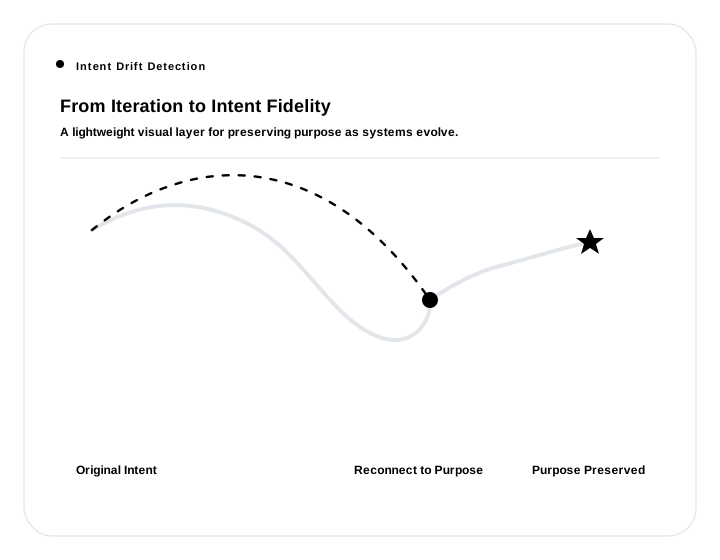
IDD started with a simple observation: every time information passes from one person, team, artifact, or iteration to another, some of the original intent is lost.
In SAFe, this happens at every layer — from Executive Vision down through Portfolio, Epic, Feature, Story, Code, and Release. At each handoff, people interpret intent differently, teams optimize for local objectives, assumptions are introduced, and context disappears.
By the time a solution reaches production, the organization may have delivered exactly what was requested in the backlog — while failing to deliver what was originally intended.
SAFe was simply the first environment where this was observed. The same pattern exists in AI-assisted development, enterprise transformation, product development, and agentic systems. The root cause is always the same.
IDD's answer: treat intent as a first-class artifact — not something buried in a kickoff deck, but something explicitly named, carried forward, and continuously validated throughout the lifecycle.
IDD is built on four distinct constructs — a principle, a mechanism, a measure, and a practice. Together they form a lightweight intent-preservation layer that sits on top of whatever delivery framework you already use.
Original intent must be captured, named, and carried forward — not left in a kickoff meeting or business case. It is a living artifact, not a historical document.
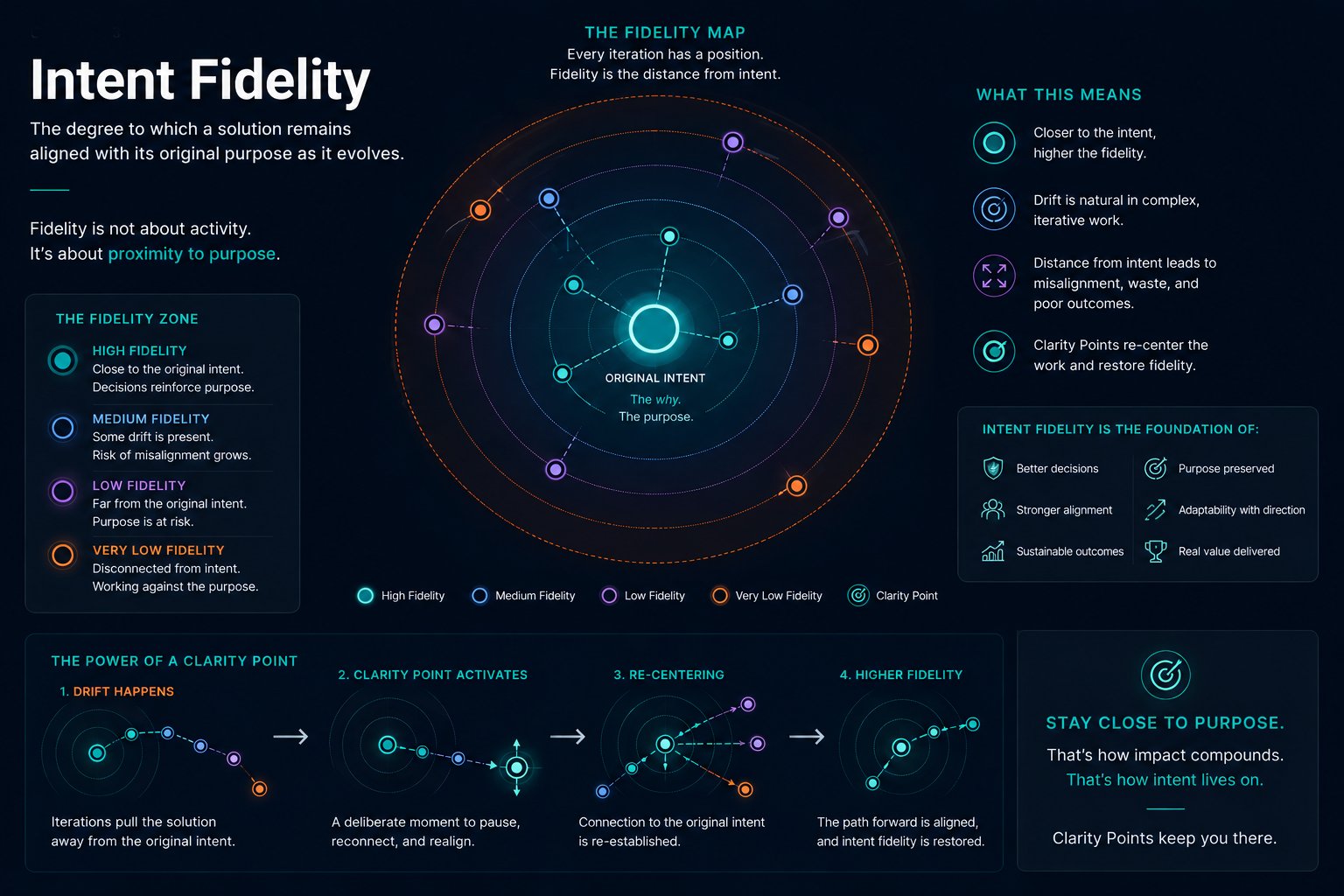
Deliberate moments throughout the lifecycle where teams resurface the original intent and ask: does what we're building still reflect why we started?
Intent Fidelity is the degree to which a solution remains aligned with its intended purpose as it evolves. It is measurable, trackable, and independent of velocity or quality metrics.
Lightweight alignment checks — not reviews or approvals — that evaluate whether execution has drifted from the original operational or business objective.
Fidelity is not about activity. It's about proximity to purpose. The closer your solution stays to the original intent, the higher the fidelity — and the more likely you are to deliver real value. Clarity Points exist to re-center the work and restore fidelity when drift occurs.
IDD emerged from SAFe enterprise delivery. AI-assisted development brought it home — because AI amplifies the same drift pattern at an order of magnitude greater speed.
Large-scale programs create many abstraction layers. Each layer introduces interpretation. IDD reconnects every work product back to the originating mission intent.
AI accelerates iteration to the point where intent degradation can occur within hours. IDD operates as an intent-preservation layer across prompts, generated code, refactoring, and agent decisions.
Clarity Points are not compliance gates. They are deliberate pauses where teams ask the questions that delivery frameworks never ask.
Not the current ticket. Not the sprint goal. The original reason this work was initiated — what problem it was created to solve.
Assumptions made at the start are rarely revisited. A Clarity Point forces teams to surface what has shifted since intent was first defined.
Technically correct, on-time, on-budget — but are we still building the right thing? This is the question most delivery frameworks never ask.
Performance, cost, and efficiency improvements can silently shift a solution away from its founding purpose. Optimization is productive drift.
IDD is a living framework, not a finished one. Whether you're navigating SAFe program complexity or AI-assisted delivery, your real-world observations help define what comes next.
Where have you seen intent drift in your own programs? What triggered it? How did you catch it?
Where does IDD break down? What edge cases hasn't it addressed? Push back — the theory gets stronger for it.
Beyond SAFe and AI — where else does iterative drift occur? Product development? Policy? Research? Tell us.
Intent Driven Designs — Last updated June 2026
Intent Driven Designs (“the Site”) is a theory and community platform dedicated to preserving original intent across iterative systems. We are committed to being transparent about how we handle any information you share with us. This policy explains what we collect, how we use it, and your rights.
The Site collects information only when you voluntarily submit the “Share Your Thinking” feedback form. That form asks for:
We do not collect any information passively. There are no tracking scripts, no analytics cookies, no advertising pixels, and no third-party trackers on this site.
Information submitted through the feedback form is used solely to:
We do not sell, rent, share, or transfer your information to any third party for marketing or commercial purposes.
Form submissions are processed and stored by Formspree (formspree.io), a third-party form backend. Formspree processes submissions on our behalf and stores them securely. You can review Formspree's own privacy policy at formspree.io/legal/privacy-policy. We do not operate our own database or server-side storage.
This site does not use cookies of any kind — not session cookies, not tracking cookies, not preference cookies. No cookie consent banner is required because no cookies are set.
The feedback form does not accept file uploads of any kind. Only text input is accepted, reducing security risk for both submitters and site operators.
This site is intended for professional audiences. We do not knowingly collect information from anyone under the age of 16. If you believe a minor has submitted information through this site, please contact us so we can remove it.
If you have submitted feedback and wish to have your information removed, or if you have questions about how your data is handled, you can contact us via the feedback form (select “Question about the framework” as your input type) and we will respond promptly.
If we materially change how we handle your data, we will update this policy and revise the “Last updated” date at the top. Continued use of the Site after changes constitutes acceptance of the updated policy.
Intent Driven Designs is created and maintained by Yahya Zia. For privacy-related enquiries, please use the “Share Your Thinking” form on this site.